Research · August 15, 2026 · 8 min
Selection is not absorption
The most useful distinction in AI visibility, and almost nobody makes it. Being named from training data and being retrieved as a source for one answer are different phenomena with different time constants — and only one of them is work an agency can sell.
By Islam Hachimi, Founder
Ask someone for a restaurant recommendation and you get two different kinds of answer. "Oh, Luigi's is great" — they already knew. Or they pull out their phone, look something up, and read you what they found.
Both end with a restaurant getting recommended. They are completely different events, and only one of them is something a restaurant can do anything about this month.
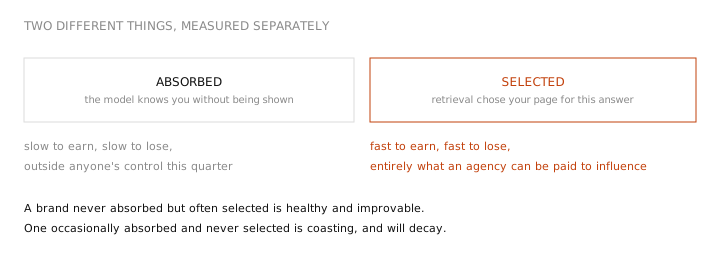
The two ways an AI mentions your business
It already knew you
The AI learned about you from everything written before it was built. It says your name without looking anything up.
Slow to earn. Slow to lose. And mostly out of your hands this quarter — it reflects how much the world wrote about you in the past.
It just looked you up
The AI searched, found your page, and used it to answer this specific question.
Fast to earn. Fast to lose. And completely within your control.
A business the AI has never heard of but keeps finding is in good shape and improving. A business it vaguely remembers but never finds is coasting on the past, and will fade.
Those two businesses need opposite advice. A single "you appear in 12% of answers" gives them the same number and tells neither of them anything.
Two lists, not one
So we record two separate things for every question we ask:
- Who was offered as a source — whatever appears in the links or references.
- Who the answer actually leaned on — whatever the text genuinely used.
These come apart constantly, in both directions:
Listed but never used. Four sources at the bottom, and the answer only really discusses two of them. The other two got a link and no attention.
Talked about but never linked. "Some people swear by Pilot, though it's aimed at funded startups." Pilot is in none of the sources. But it got recommended — and that is the signal that the AI knows the company while never finding its pages, which is a completely different problem.
The useful test: if I deleted this source, would the answer change? If not, it was decoration.
What actually gets picked up
AI does not read your page. It grabs the paragraph that answers the question. So the paragraph has to be grabbable:
- Answer in the first two sentences. Not a warm-up, not your company story. A page that buries the answer six paragraphs down loses to one that does not.
- Each bit has to stand alone. If a paragraph only makes sense after reading the three before it, it cannot be lifted out.
- Be specific. "Fast turnaround" cannot be quoted. "Most jobs finished within three working days" can.
- Use real questions as headings. With the answer directly underneath. This is not a trick — it is just a shape that is easy to find.
What actually earns mentions
In rough order of how reliably it works:
- A page that answers one question completely and nothing else.
- An honest comparison. AI gets asked to compare things constantly and has very little to work with. And a comparison that admits where a competitor is better gets used more than one that does not — the pretend-perfect version is obviously useless to everyone.
- A number nobody else has. Your own job data, your own pricing survey. The only thing a competitor cannot copy in an afternoon, and it keeps earning mentions for years.
- The page you would send a friend who asked.
- The local answer. Thin everywhere nationally, winnable in your town — and your town is where you actually compete.
Why any of this matters commercially
If you are an agency selling this, you have to justify a monthly fee to your client on Friday.
A percentage is a diagnosis. Nobody pays every month for a diagnosis they could get for free in thirty seconds.
Knowing which of the two is happening turns the number into a plan. It tells you which lever exists, how fast it moves, and what to publish this week. That is something worth paying for twelve months in a row.
Two things never worth saying
- Anything about keyword density or word counts. That is not how this works, and saying it tells a smart client you do not understand it.
- Taking credit for things you did not cause. If a business went up four points and nobody published anything, say so. AI shuffles its answers on its own, and claiming a win you did not earn is the thing that destroys trust the first time somebody checks.